
BHR4All: From A Celebration to A Movement

What BHR4All Taught Me About People, Leadership and Belonging
A couple of weeks ago, someone asked me about BHR4All. Such a surreal moment - felt like a lifetime ago! But, the memories soon flooded back. Memories of a small group of us working all hours to bring a concept to life and achieve the unthinkable.
This video (BHR4ALL 2018 - Prince Khalifa Bin Salman Park ,Bahrain) captures how a simple not-for-profit initiative evolved into a movement. It was phenomenal! All those communities came together to celebrate the uniqueness and peacefulness of the beautiful Kingdom of Bahrain and its people.
When I landed at Bahrain Airport in 1989, I had no idea that this island would change my perception of the world. What I have experienced is a nation of kindness. My hands-on work experience ranges from aviation, training, governmental communications, higher education, a motor racing team, and managing a full-service agency. I recall working on what is now the Bahrain International Circuit when it was still a rocky desert. The transformation is amazing and today, of course, it is impossible to imagine the landscape as it was then. Working in different industries has also exposed me to the precarious world of internal corporate politics. The similarities of in-house toxicity are remarkable regardless of the industry. Over the years, as the country has developed, societies/communities and people have changed. Sometimes I wonder whether, in the pursuit of material success, a certain ruthlessness has crept in at the expense of empathy and caring. I have experienced extraordinary generosity and collaboration. Sadly, I have also encountered devious behaviour that is quite frankly mind boggling! Throughout this, my enduring passion has always been to genuinely try to comprehend how individuals and societies navigate life and make decisions. The thread that weaves through everything I do is kind curiosity and learning.
It started with people.
In 2002, I became involved with the differently abled community. This is a community that does not seek attention, but one that truly deserves to be included and respected. I believe Corporate Social Responsibility campaigns (CSR) should be about genuine support without using vulnerable individuals as photo props. For years we organised numerous events in the special centres, malls and public venues. By 2012, I thought of bringing the differently abled community together with other societies or NGOs in Bahrain. The concept was to raise awareness and provide an opportunity for everyone to showcase their abilities, cultures and contributions. I reached out to the late Ms. Fatima Salman who was the first municipal council member in the GCC and served as the councillor in Busaiteen. She and her team were incredibly welcoming, motivating and supportive of the concept. After several discussions and amendments, the idea of BHR4All took shape.
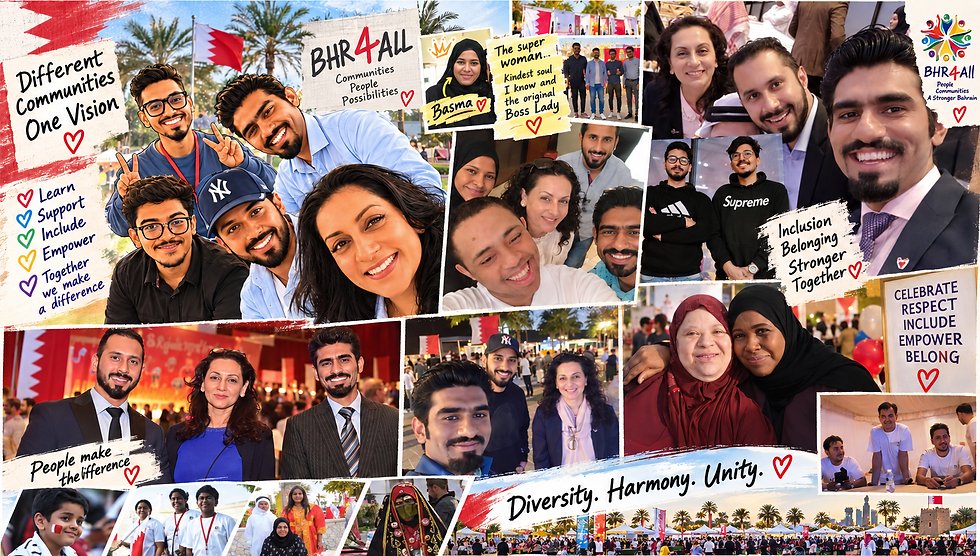
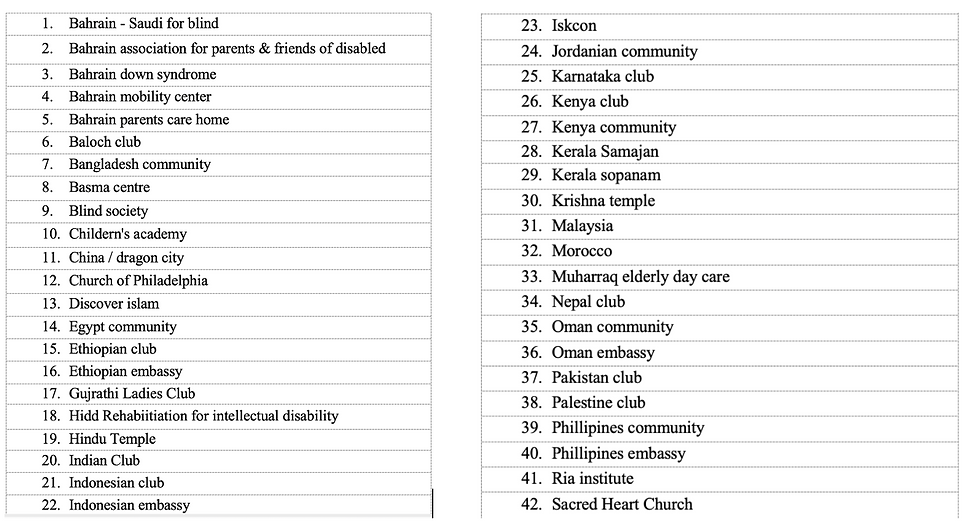
To encourage participation, a letter would not have been enough. So, I located the clubs and arranged to meet with them – one by one….a necessary but exhausting and time-consuming process. Seven clubs and about 10 market stalls eventually agreed, and we were able to plan the first event in 2013. By 2019 we had more than 45 clubs/communities and around 250 stalls, representing senior citizens, people with disabilities, different nationalities, women's groups, entrepreneurs and many others. BHR4All provided a platform for communities to come together, share what made them unique and, at the same time, learn about each other. Every community would put on extraordinary performances and displays. The amount of effort that went into making those few hours successful was astounding. People cared, and made extraordinary things happen. It was pure magic.
Working with people from so many different cultural backgrounds was a huge learning curve - for all of us. Only during my years flying had I encountered so many different cultures at once. It was fascinating. It was also, occasionally, exhausting!
Admittedly, motivating so many organisations and personalities to work effectively towards the same goal had its own challenges. Perception can be a cultural challenge. Strangely enough, sometimes what seemed to be a logistical problem was in fact a communication problem. Working under pressure is a lesson in itself. Once we had formulated a plan, I approached the private sector seeking sponsorship. Some days this was an exasperating task. Other days, it was fabulously plain sailing. Companies and the public sector helped, gave their input and offered advice - a tremendous group effort. Many years ago, we had decided that BHR4All would not be for personal financial gain - and it never was.
The people behind the photographs
Throughout the year, BHR4All volunteers would visit special centres, meet the teachers and children and encourage them to become involved. We approached sponsors for gifts and arranged parties and activities, with Gurgaon becoming one of our favourites. The volunteers went out of their way, in between their university classes, to visit the centres and spend time interacting with the students. Mohammed Usman, Salman Amjad, Abdulla Khalid and Maaz Ahmed were the key volunteers that supported every single activity.
An integral part of our team was Ms. Basma Buradha, whom I have known since 2002. Her input and gentle guidance helped us ensure that as many special centres as possible were included. Basma is the Original Boss Lady everyone hopes for. Everyone should visit the Hidd Rehabilitation Centre for Intellectual Disability where she is the headmistress. It is a privilege to witness her firm kindness and support that she brings to the people around her. I think some people change organisations simply by the way they treat other human beings. Basma is one of those unique individuals.
Not forgetting Sabeesh from Manama Press, who created the posters for each participating club – nobody was left behind. There were so many people involved that I am certain I will forget somebody, and I already apologise for that! And together we made magic.
The invisible work
The longevity and success of BHR4All was never about one person or one organisation. The photographs and videos show the colourful stalls, the performances, the crowds, the smiles and laughter. What they don't show are the personal sacrifices. Each BHR4All volunteer and participating club member made hundreds of phone calls, persuaded organisations to join, arranged transportation, negotiated supplier costs, argued and lost sleep in the weeks leading up to the event. BHR4All survived because people kept showing up. Each year when we had our meetings to plan the next event, the group was larger and more animated. The different cultures, ideas, and camaraderie were outstanding. And over time people started to believe in the vision. Once they did, they spread the word themselves. Communities arranged meetings with ambassadors. They sent information to their own wire agencies and shared the story through their networks. They took ownership. They were no longer simply participants – they became part of the story. That, perhaps, was the greatest achievement of BHR4All.
From charity to partnership
I had started with a very simple belief: people with disabilities should not be treated as objects of charity. But over time, my understanding of inclusion changed. I realised that the same principle applied much more broadly. Communities needed an opportunity to meet, to contribute, to listen to different perspectives, to be recognised and take ownership. The distinction is not just about giving but being heard. Essentially, we were not a charity asking, “What can we give them?”We were asking, “What can we build together?” That distinction has stayed with me.
Why did it work?
I suppose looking back, BHR4All was successful partly because people wanted to feel valued. They wanted to know that they had a legitimate place within the wider society around them. Each of our communities, cultures, professions, families and social circles are uniquely different. And, these groups often shape how we see ourselves and the world around us. However, our own individual circles can also be limiting.
Then BHR4All came along and created an opportunity for people to step outside those circles. It created effective intergroup contact. It was an opportunity to meet, talk, celebrate, challenge assumptions and work towards a common goal. Human beings are social creatures. Once people feel that something belongs partly to them, they stop being passive recipients. They become participants. Perhaps the journey from recognition to belonging, from belonging to participation, and from participation to ownership is more important than any of us realised. I think BHR4All also taught us that every community just needs opportunities to contribute and engage with others' unique perceptions.
That was the power of BHR4All and probably why people from all walks of life still ask about it today.
Nivs D (Friday 18th September 2026)


Comments