
Attention Becomes a Split Resource: Second-Screen Viewing

A brief look at how second-screen viewing reshapes attention, learning, marketing, and storytelling. Understand the psychology behind multitasking audiences and why media is adapting.
I think that, in this day and age, most of us (88%, according to Nielsen) are engaged with a second device while watching content on a primary screen such as a TV. The second screen keeps us in touch with our friends or family and even allows us to shop or interact with brands seen on the TV. You may think this does not matter, but it means that we have changed how we engage with content.
Brands need to connect with their current and potential audiences. Therefore, they have been forced to learn how to convert that casual attention, scanning across multiple devices, into interactive engagement that strengthens the customer’s marketing experience. Brands have learned that, instead of competing for attention, they should coordinate messages to create integrated brand experiences. For example, the Nike Phenomenal Shot campaign during the 2014 FIFA World Cup allowed fans to capture, remix, and share moments seconds after they appeared on the TV screen, thus cementing an emotional connection. If these campaigns are implemented well, they extend storytelling while sparking curiosity. Marketing specialists can track these interactions, analyse which moments drive engagement, and tailor future campaigns accordingly.
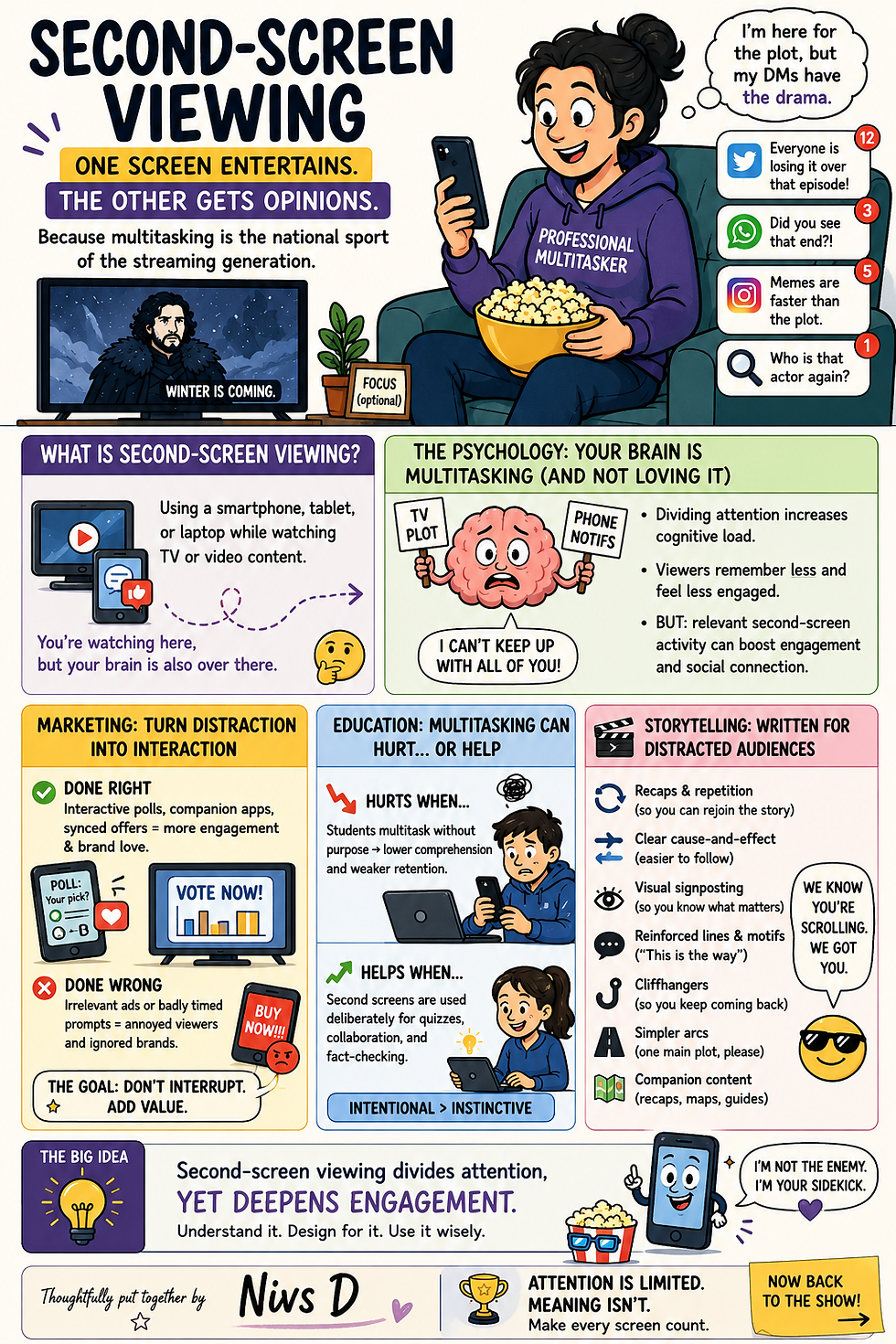
I began wondering how most of us use a TV. For some, there might seek enjoyment in a drama or sporting event. If it is live TV, people might use their devices during commercial breaks – but we notice peoe at the cinema continue to enagge with their phones. But what about people consuming hours of compelling content on platforms such as Netflix? Either way, second-screen behaviour is no longer the exception. It is not simply a distraction but reflects a deeper shift in how attention works in media and how it is continually interrupted. The paradox is that although attention is fragmented, engagement can actually increase.
Human Attention – Cognitive Limits
When an individual is trying to attend to several screens and cognitive load increases, memory is likely to suffer. Research in Cognitive Load Theory indicates that the brain struggles to integrate information when it is split across several sources. Results suggest that people engaged in second-screen viewing often recall less of what they watch. That is without assuming the activity is unimportant. For example, checking facts or participating in polls can enhance engagement because attention is redistributed rather than simply divided.
Marketing and Split Attention
I mentioned how Nike, has adapted marketing to target second-screen users. Several ddvertisers have learned to compete across devices and have developed campaigns that synchronise cross-device engagement. When implemented well, passive viewing becomes active participation.
Education and Multitasking Students
Any educator will tell you that second-screen behaviour is a double-edged sword. On one hand, it is necessary; on the other, students can become engaged in activities that have nothing to do with the subject matter – which is often the case. If students engage in unstructured multitasking during lectures, there is evidence of reduced comprehension and weaker retention. This is because every switch in attention interrupts encoding, leading to poorer retention. However, if the integration is deliberate through quizzes or collaborative tools, the second screen can support active learning. The key here is that it is not simply about using another device; it is about doing something else with intent.
Media Adaptation to Distracted Audiences
Media has cleverly adapted its storytelling to maximise the audience’s partial attention. Storytellers now use clearer narrative structures, repeated cues, and stronger visual elements that signpost the storyline. For example, shows like Stranger Things include strong visual clarity so viewers can quickly reorient themselves, while some productions rely on direct cause-and-effect sequences to maintain coherence in case attention drifts. Do you remember the structural recaps in series such as Grey's Anatomy or Parenthood, which helped anchor fragmented attention? In short, storytelling is adapting to viewers not always being fully present.
Conclusion
In conclusion, second-screen viewing reflects how attention now operates in an age where we are inundated with technology and connected devices throughout our daily lives. In the past, people waited for commercial breaks to make a snack; now audiences pause at any time and move back and forth between devices. This can reduce memory in some areas while increasing engagement in others, and it has permanently reshaped marketing. Brands now need to consider cross-platform design and creative storytelling if they want to make a lasting impression. What is the modern challenge we all face? It is to minimise distraction while continuing to engage and communicate meaningfully within this new digital landscape.
Ends
Nivs D (Friday 3rd July 2026).
Further reading:
Cognitive load theory and individual differences - https://www.sciencedirect.com/science/article/pii/S1041608024000165
Efficient, helpful, or distracting? A literature review of media multitasking in relation to academic performance: https://link.springer.com/article/10.1186/s41239-018-0096-z
Examining the impact of off-task multi-tasking with technology on real-time classroom learning: https://www.sciencedirect.com/science/article/abs/pii/S0360131511002077
Nike Phenomenal Shot: https://www.commarts.com/project/23879/nike-phenomenal-shot
TV no longer commands our full attention: Effects of second-screen viewing and task relevance on cognitive load and learning from news: https://www.sciencedirect.com/science/article/abs/pii/S0747563214002994
What is second screening and why it matters: https://www.infobip.com/glossary/second-screening



Comments