
Inside the Fragmented Mind: Trauma, Crime, and the 24 Faces of Billy Milligan

From Abuse to Acquittal: Understanding Dissociative Identity Disorder (DID)
In 1978 Milligan became the first person in US history to be acquitted of kidnapping, robbery and rape on the grounds of insanity due to Dissociative Identity Disorder (DID), previously known as Multiple Personality Disorder. At that time, the public were fascinated but left academics and experts divided. People were confused as to whether he was a violent criminal and was faking mental illness or if he really was a deeply traumatised individual whose mind had formed separate identities in a n attempt to avoid unimaginable pain.
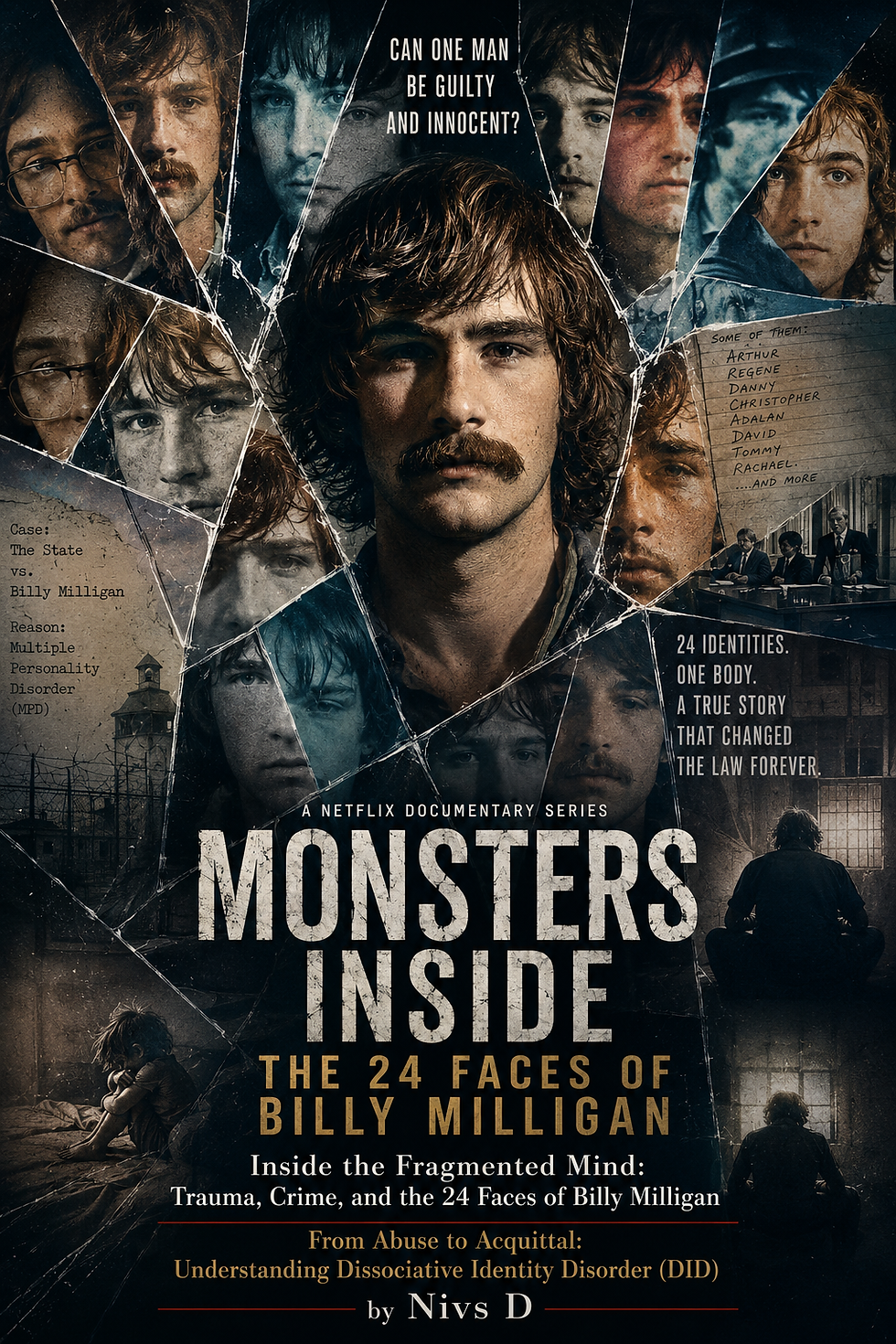
Netflix’s Monsters Inside: The 24 Faces of Billy Milligan attempts to identify the layers of trauma, psychiatry and ethics. During the 1970 this case contested the processes of criminal responsibility, mental illness and legal accountability. But was Billy Milligan a criminal, or a result of DID and its diagnosis according to the (Diagnostic and Statistical Manual of Mental Disorders) DSM-5? What were the unusual psychological and psychiatric perspectives that surrounded the case?
DID is possibly one of the most complex and misunderstood psychiatric conditions. In the DS, the condition was characterised with the presence of two or more distinct personality states/identities that would alternately control an individual’s behaviour. However, in criminal trials, any appeals on the ground of insanity due to DID were exceptional and extremely contentious. Thus, Milligan’s acquittal of a serious crime, on the grounds of insanity raised many questions. His defence had argued that the acts were committed without him being aware by one of his 24 personalities. As you can imagine, this drew a great deal of public attention surrounding DID. Cynicism towards DID and its validity in criminal law has grown with concerns of malingering and inconsistent expert testimony. Thus, Milligan’s case remains a unique exception as the courts continue to be hesitant to accept DID as grounds for acquittal.
Since then courts have typically rejected defenses of insanity: such as State v Greene in 1998 and State v Lockhart in 2000. In these cases, unreliable evidence and failure to meet legal insanity standards were cited. The case is a legal anomaly, leaving society with much confusion and responsibility when the lines between illness and accountability are blurred.
Let’s go back to what happened.
The Crime and Arrest of Milligan
In 1977 a 22-year-old man was arrested for the violent assaults close to Ohio University. The evidence found that Billy Milligan was responsible for these violent crimes, but he appeared to be visibly confused and claimed to have no memory of the attacks. As a result, he was placed under psychiatric evaluation. However, an astonishing picture emerged when Milligan claimed that there were people inside him who took control during the crimes and he could not recall anything. Eventually 24 personalities both good and bad with their own names, accents, abilities and memories revealed themselves. For example, 1) Arthur was a British intellectual who handled logic and reason, 2) Allen was a manipulator and con artist, 3) Tommy was a clever escape artist and 4) Ragen a Yugoslav communist who handled aggression and strength. At the core was Billy who claimed to be unaware of what the personalities had done. Although for mental health experts, the case was an invitation to explore how the human mind can fragment or divide itself under distress, there were the legal responsibilities. Who could the legal system find guilty if one personality committed a crime, but the other one had to stand trial? This was a real dilemma.
What is DID?
According to the DSM, each identity in a person suffering from DID can have its own memories, attitudes, and physiological differences such as handwriting, voice and even allergies. The individuals can forget normal events/traumatic episodes while one identity is in charge, and the core self has profound memory lapse. The symptoms can include:
1. Depersonalization: feeling detached as if they are observing life from outside of their body.
2. Derealization: observing the external world as dreamlike or imaginary.
3. Distress or impairment in social, occupational, or personal functioning.
These symptoms are not explained by substance abuse, cultural rituals or neurological conditions. It is a condition that is almost always rooted in severe, chronic childhood trauma and in particular physical, emotional and sexual abuse. Experts believe that the mind splits into different parts if a person is overwhelmed with truly torturous experiences. Subsequently, each segment carries its own fragment of that memory into an emotion but the whole self is unable to integrate. In Billy’s case the diagnostic framework used by the specialist was a fit because he: 1) exhibited 24 unique personalities, 2) was unable to remember the actions of other personalities, 3) was faced a disrupted life, 4) did not have drug-related or neurological causes. Finally, all of these went beyond the scope of accepted spiritual or cultural expression. Billy Milligan’s childhood experiences and crime highlight how a person’s identity, memory and consciousness can fracture in such a way that each shard lives a separate autonomous life within one brain.
Brain Function and DID
Modern neuroscience has been key in having the technology to validate what might have been dismissed as fiction. Research has indicated that people with DID exhibit different neural activity for each identity.
Studies indicate that people with DID exhibit distinctive neural patterns of neural activity for different identities. The memory gaps can be explained by the variations in activity of the hippocampus (memory) and the amygdala (emotion) which are critical for memory and processing emotions. This means that different personalities engage different neural circuits. Additionally the condition is associated with malfunction in the prefrontal cortex which is associated with decision-making and executive function. Meaning that the mind might not be able to maintain a unified sense of self.
Childhood trauma can disrupt normal development of the neural circuits and make it difficult for the brain to integrate experiences. If I apply this to Billy Milligan experiencing severe abuse as a child, the personalities may have emerged as adaptive responses for him to cope with the agony and distress that his primary identity could not tolerate. This may explain why Milligan had no conscious memory of when one personality carried out an action. Does this mean that his personalities were not merely psychological constructs but neurobiological realities? This would explain that each of the personalities could operate almost independently without being aware of the others.
Psychiatric and Legal Controversy
Milligan’s case was highly controversial. Some mental health experts argued his condition was genuine with the crime being committed by alternate identities that were in control. While others insisted that they were being manipulated and that he was malingering his symptoms. The court eventually accepted the DID diagnoses and found him not guilty by reason of insanity. Consequently, he was committed to a psychiatric hospital where he remained for about 10 years. After further brushes with the law he was cleared in 1988 and lived a quiet life until he died of cancer at the age of 59 years old in 2014.
But this case was important in igniting fierce debate. Should a person be held legally accountable for actions committed by an identity that they cannot control? What is insanity? Is it a symptom or is it a defence? This case also forced the justice system to face the tangled web of psychology, psychiatry and the law.
Perhaps we can learn a lot from examining his life and science behind childhood development. Maybe we can gain more insight into the capacity for adaptation under trauma in adjudicating crimes committed by those with profound psychiatric conditions.
Nivs D (Friday 7th August 2026)



Comments